A few days can feel like a very long time in the stock market. During the week ended November 20, the S&P 500 fell 8.6%, and the Nasdaq dropped 10.0%. The S&P ended that week 11.6% below its October 6 record. On Monday, November 23, Nvidia’s surprise decision to reinstate Jensen Huang as CEO sparked a powerful rally: the S&P gained 4.7%, and the Nasdaq rose 6.5%. The following day, those indexes gave back some of their gains, falling 0.5% and 1.5%, respectively. Selling pressure returned in early trading on Wednesday, November 25.
Those reversals illustrate why making investment decisions based on the latest headline is so difficult. An investor who sold on November 20 would have faced a decision about buying back into a sharply higher market on November 23, before many of the questions that prompted the selling had been answered. The renewed selling that followed showed how quickly relief can give way to uncertainty again.
Neither a powerful rally nor a fresh round of selling settles the longer-term questions facing investors. Watching hard-earned savings decline is uncomfortable, especially when the losses arrive quickly. Our job is to take those concerns seriously, assess what has changed, and help clients maintain portfolios they can hold through periods of uncertainty. That approach matters on the way up as much as on the way down.
Remember how last year felt
The tariff turmoil of April 2025 offers a useful reminder. Recession fears were widespread, and policy was changing rapidly. In our commentary at the time, we wrote about the danger of reacting to alarming headlines and the tendency for some of the market’s strongest days to occur during its most unsettling stretches. The S&P 500’s 9.52% gain on April 9 was a striking example. By late June, the S&P 500 and Nasdaq had returned to record highs.
That recovery looks much simpler in hindsight than it felt to live through. The risks behind November’s selloff differ from last year’s, and the V-shaped rebound of 2025 is no timetable for another recovery. The lesson is that an investor waiting for everything to feel safe may find that prices have recovered before confidence has.
AI has promise and investors still have questions
Much of November’s uncertainty has centered on the enormous investment required to build AI infrastructure. Strong Nvidia earnings and demand are encouraging, but they do not answer every question about the industry’s financing or eventual profitability. Huang’s return on November 23 addressed an immediate leadership uncertainty. In announcing that decision, Nvidia said its independent investigation would continue. The broader questions about AI investment extend beyond who leads the company.
AI can deliver substantial productivity gains, yet investors still face considerable uncertainty about which businesses will capture those gains and how long it will take. A technology’s success does not guarantee an attractive return on every investment associated with it.
The timing matters. Data centers require substantial upfront spending on power, equipment, and construction. Customers must eventually generate enough revenue to justify those costs. Meanwhile, rapidly improving chips could become economically obsolete sooner than expected. Fierce competition could also benefit AI users while limiting the profits of the companies supplying it. These are legitimate investment questions, even for those of us who are optimistic about the technology.
Financing adds another layer. When suppliers invest in customers who then buy their products, the relationships can support growth, but they also make it harder to gauge how much demand ultimately rests on independent, paying end users. A disruption at one company can affect its suppliers, investors and lenders. We have been discussing these interconnected arrangements for some time; a rally does not make the issue disappear.
There is also a constructive possibility. A more measured buildout could reduce overbuilding, ease pressure on scarce resources, and allow the largest technology companies to retain more cash. We continue to see a substantial need for computing infrastructure. Some projects being delayed or subjected to greater financial discipline need not mean the long-term opportunity has vanished. The key distinction to watch is between a manageable slowdown and a financing contraction that forces projects to be abandoned.
Policy will help determine how smoothly that adjustment proceeds. Stricter export controls and local resistance to data centers can affect where investment occurs, how much it costs, and how quickly it proceeds. The new U.S. tariff proposals reported on November 25 added another source of uncertainty about costs and trade. Protecting national security and addressing communities’ concerns are legitimate goals, but the rules also need to give businesses enough clarity to plan. Workable permitting could ease constraints on power and construction, while unpredictable restrictions could make an already expensive buildout even more difficult. Washington can help create the conditions for a sustainable expansion or add to the disruption. We can recognize its influence without making a portfolio depend on correctly predicting its next decision.
The economy provides reasons for perspective
The importance of AI spending also explains why a technology selloff raises concerns about the broader economy. A sustained retreat in that spending could hurt suppliers and employment, while falling stock prices could weigh on consumption. The dot-com collapse is a reminder that a technology bust can spill into the broader economy. But a recession is not an automatic consequence of a correction. On November 25, the government revised third-quarter economic growth up to a 4.3% annualized rate, reflecting stronger consumer spending and investment than previously estimated. That provides evidence of economic resilience, although a strong quarter does not guarantee that growth will continue at the same pace.
Corporate earnings also provide reasons for perspective. As the third-quarter reporting season approached its end in November, materials, industrials, utilities, communications services and healthcare each posted earnings growth above 9% from a year earlier. This breadth matters: the economy’s capacity to generate profits extends beyond the companies dominating the AI headlines. Continued economic growth at a more moderate pace remains a plausible outcome, even as investors reassess the technology sector.
Whether that growth continues will depend in part on the Federal Reserve’s next decisions. The inflation report released on November 25 showed that the core personal consumption expenditures price index, which excludes food and energy, was up 3.3% from a year earlier in October. Inflation remains too high for the Fed to declare victory, and the new data are a reminder that the path remains uncertain. Lower energy prices and an improvement in the Iran conflict could eventually provide relief, but that is a possibility to monitor rather than a reason to assume inflation is already under control. The Fed must weigh the risk of allowing inflation to persist against the risk of unnecessarily weakening the economy.
Putting valuations in context
Those economic conditions and earnings prospects provide the context for assessing valuations. In its November 20 report, FactSet put the S&P 500’s forward price-to-earnings ratio at 17.1, below its 10-year average of 19.1. That ratio compares stock prices with analysts’ expected earnings over the next year. These figures illustrate how a pullback can reduce the price investors pay for anticipated profits. Both prices and earnings estimates continue to change, so the comparison is a historical snapshot rather than a fixed measure of the market’s attractiveness.
The qualification is the earnings estimate itself. If profits disappoint, an apparently inexpensive stock can prove costly. Even so, lower valuations can improve prospective returns when the underlying business remains sound. We should examine both the price and the business outlook, rather than treating a falling share price as proof that an investment has become worse.
Short-term prices can also move much faster than the business outlook changes. Buying and selling by hedge funds and other large investors can amplify market swings. That may help explain their speed, but it is difficult to isolate in real time. Neither forced selling nor a rebound driven partly by investors buying back shares provides a dependable signal about where the market will go next.
Volatility is the price of admission
The speed and magnitude of those reversals are part of the risk investors accept in pursuit of higher long-term returns. That risk has to mean something: there will be periods of loss, uncertainty, and difficult decisions. The reward is neither guaranteed nor earned on a predictable schedule. A realistic investment plan makes room for these periods before they arrive.
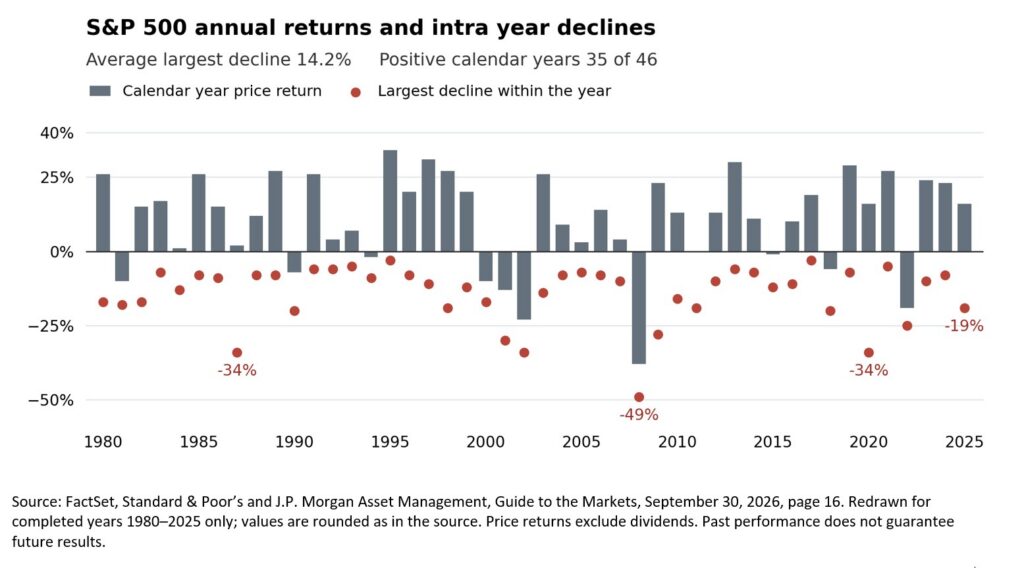
From 1980 through 2025, the S&P 500’s largest intra-year decline averaged 14.2%. Yet the index finished higher in 35 of those 46 years. Those two facts belong together. A year that looks rewarding in a long-term chart may have included a very difficult stretch for the people investing through it.