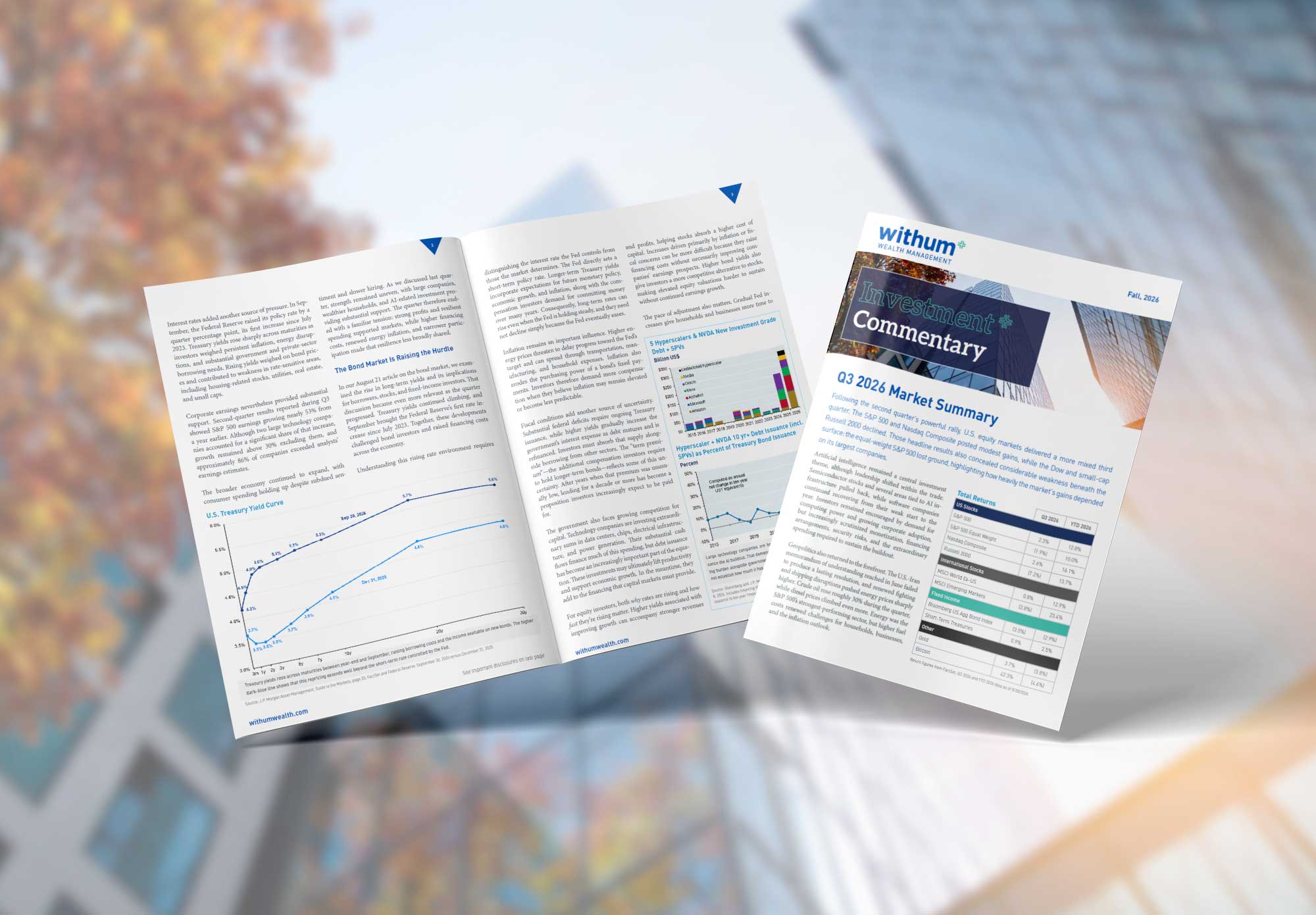
Following the second quarter’s powerful rally, U.S. equity markets delivered a more mixed third quarter. The S&P 500 and Nasdaq Composite posted modest gains, while the Dow and small-cap Russell 2000 declined. Those headline results also concealed considerable weakness beneath the surface: the equal-weight S&P 500 lost ground, highlighting how heavily the market’s gains depended on its largest companies.
Artificial intelligence remained a central investment theme, although leadership shifted within the trade. Semiconductor stocks and several areas tied to AI infrastructure pulled back, while software companies continued recovering from their weak start to the year. Investors remained encouraged by demand for computing power and growing corporate adoption, but increasingly scrutinized monetization, financing arrangements, security risks, and the extraordinary spending required to sustain the buildout.
Geopolitics also returned to the forefront. The U.S.-Iran memorandum of understanding reached in June failed to produce a lasting resolution, and renewed fighting and shipping disruptions pushed energy prices sharply higher.
Please remember that past performance may not be indicative of future results. Different types of investments involve varying degrees of risk, and there can be no assurance that the future performance of any specific investment, investment strategy, or product (including the investments and/or investment strategies recommended or undertaken by Withum Wealth Management (“WWM”), or any non-investment related content, made reference to directly or indirectly in this blog will be profitable, equal any corresponding indicated historical performance level(s), be suitable for your portfolio or individual situation, or prove successful. Due to various factors, including changing market conditions and/or applicable laws, the content may no longer be reflective of current opinions or positions. Moreover, you should not assume that any discussion or information contained in this blog serves as the receipt of, or as a substitute for, personalized investment advice from WWM. WWM does not make any representations or warranties as to the accuracy, timeliness, suitability, completeness, or relevance of any information prepared by any unaffiliated third party, whether linked to WWM’s web site or blog or incorporated herein and takes no responsibility for any such content. All such information is provided solely for convenience purposes only and all users thereof should be guided accordingly. To the extent that a reader has any questions regarding the applicability of any specific issue discussed above to his/her individual situation, he/she is encouraged to consult with the professional advisor of his/her choosing. WWM is neither a law firm nor a certified public accounting firm and no portion of the blog content should be construed as legal or accounting advice. A copy of the WWM’s current written disclosure Brochure discussing our advisory services and fees is available for review upon request or at www.withumwealth.com. If you are a WWM client, please contact us in writing, if there are any changes in your personal/financial situation or investment objectives for the purpose of reviewing, evaluating, or revising our previous recommendations and/or services, or if you would like to impose, add, or to modify any reasonable restrictions to our investment advisory services. Unless, and until, you notify us, in writing, to the contrary, we shall continue to provide services as we do currently. Please also remember to advise us if you have not been receiving account statements (at least quarterly) from the account custodian.
Downloads
Fall 2026 Investment Commentary
The third quarter offered reasons for confidence alongside reminders of the risks. Corporate profits remained strong, consumers continued spending, and investment in new technology supported activity. Higher financing costs and pressure on household purchasing power nevertheless warrant attention, particularly when market gains depend on a relatively narrow group of companies.
Those same economic pressures will also help shape November’s midterm elections and the policy outlook for 2027.